Supabase policies: test inserts updates and deletes separately
A scoped supabase row level security policy workflow with synthetic conditions, expected outcomes, evidence checks and practical next steps.

Direct answer
For supabase row level security policy, use a reproducible fixture, explicit expected outcomes and evidence of the final business state. Read access does not imply safe writes; document SELECT, INSERT, UPDATE and DELETE expectations independently.
This is a scoped method for a founder or agency reviewing an existing app or integration. It defines test expectations; it does not describe an audit performed on a client system.
Define the fixture and policy
Create two synthetic users and a table with an explicit ownership policy for each operation.
Use an authorized test environment and synthetic records. Record the release, identities, initial state and dependency conditions. Replace the example policy with your approved product policy before running the checks. If the required outcome is undecided, resolve that decision before classifying the implementation as defective.
Worked example and acceptance matrix
| Condition | Agreed expectation | Evidence to inspect |
|---|---|---|
| SELECT other row | Private read is denied | Returned row identifiers |
| INSERT forged owner | Forbidden ownership is rejected | Stored row inventory |
| UPDATE or DELETE other row | Other user's record remains intact | Before and after values |
All rows begin NOT RUN. The expectations belong to this example, not every product or provider. Preserve fail and blocked results rather than counting an unavailable dependency as a pass.
Run the conditions independently
1. SELECT other row
Set up this condition deliberately rather than waiting for it to occur during an ordinary click-through. For this fixture, the acceptance condition is private read is denied. Capture returned row identifiers and compare it with the agreed initial state. A different result needs a reproduction record; missing access to that evidence makes the case blocked. Keep the condition separate from the other rows so one successful case cannot conceal a failure here.
2. INSERT forged owner
Set up this condition deliberately rather than waiting for it to occur during an ordinary click-through. For this fixture, the acceptance condition is forbidden ownership is rejected. Capture stored row inventory and compare it with the agreed initial state. A different result needs a reproduction record; missing access to that evidence makes the case blocked. Keep the condition separate from the other rows so one successful case cannot conceal a failure here.
3. UPDATE or DELETE other row
Set up this condition deliberately rather than waiting for it to occur during an ordinary click-through. For this fixture, the acceptance condition is other user's record remains intact. Capture before and after values and compare it with the agreed initial state. A different result needs a reproduction record; missing access to that evidence makes the case blocked. Keep the condition separate from the other rows so one successful case cannot conceal a failure here.
Save a reproducible test record
The following original fixture can be copied into a test plan. Its identifiers are synthetic. It contains no production credentials and does not make network requests.
{
  "example": "synthetic; not executed",
  "scope": "Create two synthetic users and a table with an explicit ownership policy for each operation.",
  "cases": [
    {
      "id": "day-43-case-1",
      "condition": "SELECT other row",
      "expected": "Private read is denied",
      "evidence": "Returned row identifiers",
      "status": "NOT RUN"
    },
    {
      "id": "day-43-case-2",
      "condition": "INSERT forged owner",
      "expected": "Forbidden ownership is rejected",
      "evidence": "Stored row inventory",
      "status": "NOT RUN"
    },
    {
      "id": "day-43-case-3",
      "condition": "UPDATE or DELETE other row",
      "expected": "Other user's record remains intact",
      "evidence": "Before and after values",
      "status": "NOT RUN"
    }
  ]
}
Add the actual result, a redacted evidence reference and the environment after execution. Reset state between cases that mutate records. When a response is uncertain, inspect the business receipt or persisted state before repeating the action.
Interpret the result and choose the next step
Read access does not imply safe writes; document SELECT, INSERT, UPDATE and DELETE expectations independently.
A failure report should name the affected condition, the observed difference and its business impact. A blocked result should name the missing dependency and its owner. After a repair, rerun the original failure and a relevant ordinary path against the new release. Keep untested conditions visible. This matrix does not establish exhaustive security, compliance, performance or integration coverage.
Use the paired tool
Supabase RLS Checklist Builder provides a practical companion. Its dated enhancement is CRUD-specific evidence checklist. The planning worksheet creates named cases and exports your recorded outcomes; it does not automatically exercise your app. Use the tool's existing calculation or validation separately where relevant.
Implementation reference
Consult Supabase row-level security for the underlying platform or method. The source is an implementation reference; the fixture and product expectations above are original illustrative conditions, not quoted provider guarantees. Confirm the documentation for your deployed version before implementation.
Frequently asked questions
What demonstrates select other row?
For this fixture, private read is denied. Inspect returned row identifiers; a success message alone may not establish the approved outcome.
What if insert forged owner cannot be reproduced?
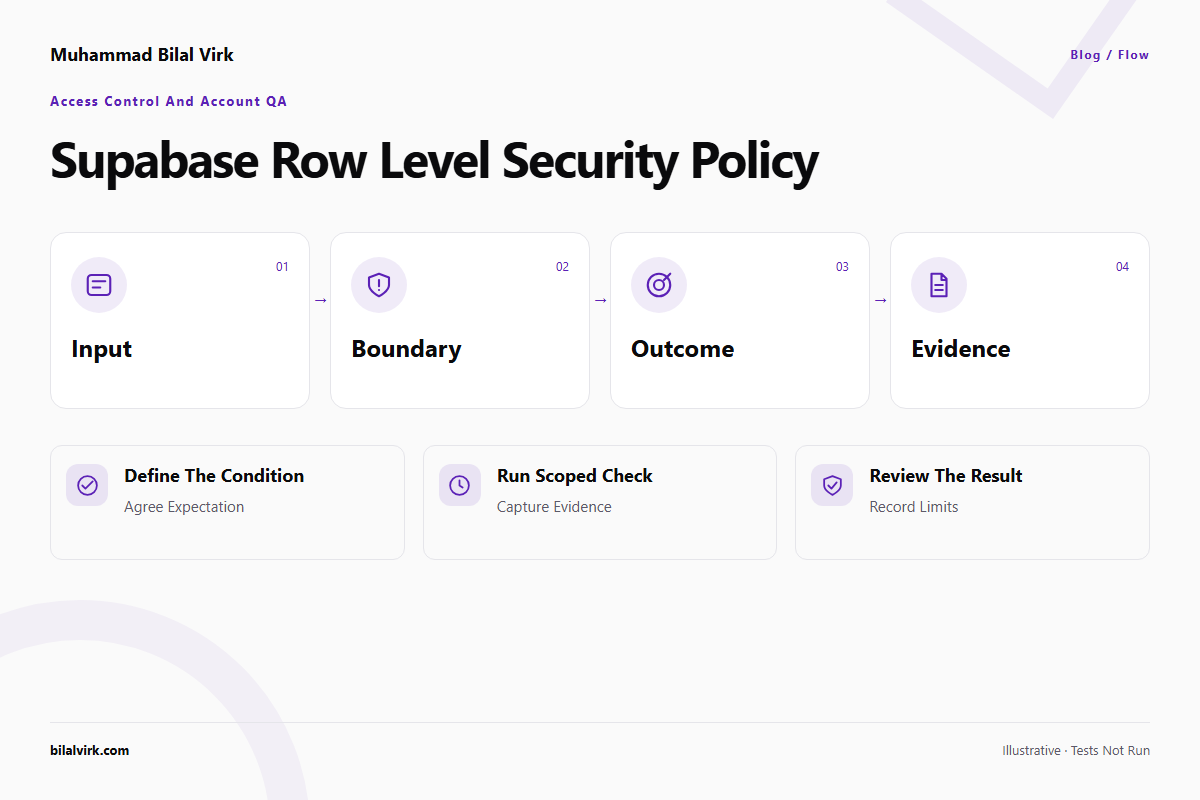
Record it as blocked with the missing setup or dependency. Do not replace the missing evidence with the image or a generated expectation. The diagram is instructional, and this article reports no executed result.
When is a scoped review useful?
Request one when a critical condition fails, ownership is unclear or the team cannot determine what committed. Bring the reproduction and agreed policy.
Recommended action
Start with the matrix for supabase row level security policy, then record evidence before accepting or repairing the result. Discuss a scoped AI app audit or book a discovery call. Share the stack and broken journey in the initial enquiry; arrange any required access separately.
Want this built against your real numbers?
A 30-minute call to scope the workflow, agent, or automation you actually need.